INDIA · FERTIGATION AUTOMATION
Is There a Subsidy for Fertigation & Drip Automation Controllers in India?
What is eligible, how controller components fit within PDMC, and how to prepare a subsidy-ready application.
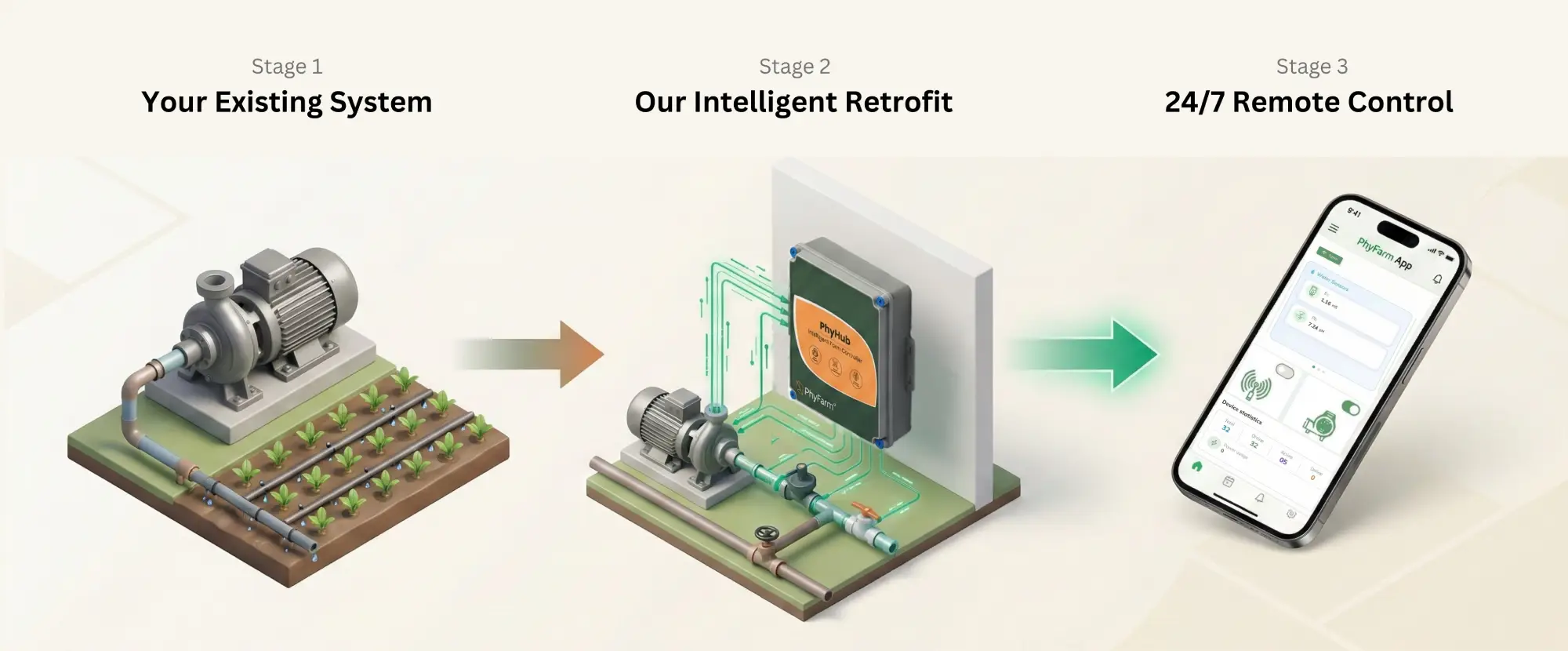
Yes. Under India’s Per Drop More Crop (PDMC) programme within PMKSY, micro-irrigation subsidy covers more than the drip pipe alone. The automation and fertigation component — the controller, sensors, solenoid valves and dosing unit — is listed as a separate eligible item. The exact amount depends on your state, farmer category and the current year’s notified rates, so always confirm the figure on your state portal before you buy.
Most farmers know the drip pipe and sprinklers are subsidised. Fewer know that the automation and fertigation component — the smart controller, sensors, solenoid valves and the dosing (fertigation) unit — is separately listed as an eligible item under PMKSY / Per Drop More Crop guidelines.
What does the fertigation & automation subsidy actually cover?
Most farmers know the drip pipe and sprinklers are subsidised. Fewer know that the automation and fertigation component — the smart controller, sensors, solenoid valves and the dosing (fertigation) unit — is separately listed as an eligible item under PMKSY / Per Drop More Crop guidelines.
This matters because the controller is the part that actually saves you labour, water and fertiliser. A subsidy that only pays for pipe leaves the “brain” of the system unfunded. When the automation component is included, a much larger share of a complete precision-irrigation setup becomes eligible for support.
Because the eligible amount for automation and fertigation is state-notified and revised periodically, treat any specific figure you read online as indicative only, and verify it with your local Agriculture or Horticulture office before purchasing.
How the subsidy is structured: central base plus state top-up
The single most useful way to understand micro-irrigation subsidy in India is:
Total subsidy = central PDMC base + your state’s top-up.
The central PDMC scheme sets a baseline share of unit cost, differentiated by farmer category (small and marginal farmers typically get a higher share than “other” farmers). Most states then add their own top-up over this base — which is why farmers in states like Maharashtra and Gujarat often receive an effective subsidy above the central baseline.
Administratively, PDMC ran under PMKSY and, from 2022-23, was brought under the Rashtriya Krishi Vikas Yojana (RKVY). Many portals and field officers still say “PMKSY Per Drop More Crop”, so both names refer to the same farmer benefit. Confirm the current umbrella scheme name at the time you apply.
State-wise micro-irrigation subsidy at a glance
The table below shows how the subsidy is administered in some of PhyFarm’s core states. Percentages, dark-zone lists and application windows change by Government Resolution or circular, so use this as a map of which portal and process applies — not as a guaranteed rate.
Important: every rate, dark-zone list, eligible-crop list and application window is time-sensitive and state-notified. Confirm the current figure with your Agriculture or Horticulture office, your KVK, or the official state portal before purchasing. No subsidy percentage should be treated as a guaranteed entitlement.
Who is eligible for the automation & fertigation subsidy?
Broad eligibility is fairly consistent across states, even though rates differ:
- You are a farmer with cultivable land in your name, or with a valid tenancy or land record.
- You hold a valid land record — typically the 7/12 extract (satbara), RTC or land registry.
- Your Aadhaar is seeded to a bank account for Direct Benefit Transfer (DBT).
- Most states apply a per-beneficiary area cap and give higher rates to small, marginal, SC and ST farmers.
- The system is supplied and installed by a vendor empanelled with the state’s micro-irrigation authority.
That last point is where many farmers get stuck: the subsidy only releases if the equipment is bought through an empanelled vendor using an approved quotation format. This is where working with an established supplier removes friction.
What documents do you need to apply?
The typical document checklist across state portals is short and consistent:
- Aadhaar card, for DBT subsidy transfer to your bank.
- Land ownership proof — 7/12 extract, RTC, land registry or fasal record.
- Bank passbook or account details, Aadhaar-seeded.
- Quotation from an empanelled vendor for the drip, automation and fertigation system.
- A completed farmer profile or crop survey on the state portal, with any land encumbrance (boja) cleared.
How do you apply for the drip automation subsidy?
While each state portal looks different, the underlying flow is the same:
- Register on your state portal (for example MPFSTS in Madhya Pradesh, MahaDBT in Maharashtra, or GGRC in Gujarat) using Aadhaar, mobile number and OTP.
- Complete your farmer profile with crop and land details.
- Choose an empanelled vendor and get an approved quotation for the drip, automation controller and fertigation unit.
- Upload documents and submit your application within the open window (states often run time-boxed rounds).
- Get pre-approval, then install. The system is installed and verified, and the subsidy is credited to your bank account by DBT.
Approval timelines vary by state and by how complete your paperwork is. Applications tend to surge before Kharif (June–July) and Rabi (October–December), so applying early in a window helps.
How PhyFarm helps you use the automation subsidy
PhyFarm’s PhyHub, PhyOne and PhyJet automation and fertigation systems sit exactly where the scheme’s automation and fertigation component applies — the controller, sensing and dosing that turn a plain drip layout into a precision system. Points that matter for a subsidy-backed purchase:
- Subsidy-scheme compatibility with documentation support, including vendor-registration help in states such as Madhya Pradesh, so your paperwork matches what the portal expects.
- Retrofit-friendly: automation can be added onto your existing pumps, valves and tanks, rather than forcing a full rebuild.
- Offline-first control: schedules keep running even when the internet drops, with built-in voltage and dry-run protection for your pump.
- Proven savings: across 150+ Indian farms and research institutions, PhyFarm reports water savings of up to 30–50% and fertiliser savings of 20–30%, with return on investment often within 1–2 seasons.
- Backed service: a 45-day structured install with certified technicians, a 1-year warranty and a 5-year AMC, with agronomy validated alongside institutions such as CPCT and IARI.
When a share of the automation component is subsidised and the balance pays back over a season or two through water, fertiliser and yield gains, the economics of automating your farm change substantially.
Which crops benefit most from subsidised fertigation automation?
High-value, fertigation-responsive crops tend to see the fastest payback. Explore crop-specific setups for grape fertigation and drip automation, sugarcane drip and fertigation, and pomegranate (Bhagwa) fertigation, or browse all crop-wise fertigation guides. You can also review the filters, valves and dosing accessories that complete a micro-irrigation system.
Frequently asked questions
PMKSY / Per Drop More Crop guidelines list the automation and fertigation component as an eligible item, not just the drip pipe. The exact eligible amount depends on your state’s current notification, so confirm it on your state portal before buying.
The subsidy is built as a central PDMC base plus a state top-up, and it varies by farmer category, state and year. Small and marginal, SC and ST farmers generally receive a higher share. Because rates change by Government Resolution, check the live figure with your Agriculture or Horticulture office or your KVK.
PhyFarm systems are retrofit-friendly and can be added onto existing pumps, valves and tanks. Whether a retrofit qualifies under your state’s current window depends on the notified components and vendor empanelment, so verify eligibility for your specific case before applying.
Yes. Almost every state requires the system to be supplied and installed by a vendor empanelled with the micro-irrigation authority, using an approved quotation. PhyFarm provides documentation and vendor-registration support to make this straightforward.
It varies by state and by how complete your documents are, and states often run time-boxed application rounds. Applying early in a window — especially before Kharif or Rabi — gives the best chance of timely approval.
Ready to automate your farm with subsidy support?
If you would like help checking your state’s current subsidy, preparing your documents and choosing the right automation and fertigation setup for your crop, book a demo or talk to the PhyFarm team. We can walk you through eligibility, vendor registration and a system sized to your farm.